

Clearing Up Trump Accounts and One Move Solo Business Owners Shouldn't Miss
I've had the same conversation four times since the launch of Trump Accounts. Someone tells me their kids don't qualify because they were born before 2025. That's not true. Let's clear it up.

The Myth: “My Kids Don’t Qualify”
The $1,000 seed contribution only goes to U.S. citizen kids born between January 1, 2025, and December 31, 2028. That’s the number that made every headline.
But any child under 18 with a Social Security number can have a Trump Account opened for them. Your 14-year-old counts. Your 9-year-old counts. They just won’t get the free $1,000.
If you have kids under 18 without an account, consider opening one.
Family and Friend Contributions Aren’t Deductible
If you or a grandparent contributes out of pocket, that money is not tax deductible for anyone, per Section 128 employer plan guidance. It goes in after tax, similar to a Roth contribution.
One more important point: the $5,000 annual cap is shared, not stacked. If an employer contributes $2,500, everyone else can only add up to another $2,500 to reach the same $5,000 ceiling. Said another way, if five family members want to contribute, they can only contribute a total of $5,000, not $5,000 each. It’s one bucket.
The Real Opportunity: A Business-Funded Program
Here’s the part worth your attention if you own a business, especially as a solo owner paying yourself W-2 wages through an S corp.
Under Code Section 128, an employer can contribute up to $2,500 per employee, per year, into that employee’s kids’ Trump Accounts. It’s excluded from the employee’s W-2 income and deductible to the business. Making the contribution personally gets you neither benefit.
Say you run a solo consulting practice as an S corp, pay yourself a reasonable salary, and have two kids under 18. Adopt a written Trump Account Contribution Program (TACP) through your business, and contribute $2,500 a year, split however you like between your kids’ accounts. That’s $2,500 the business deducts, that never touches your personal return, funding your kids’ accounts with dollars that would otherwise have been taxed on the way there.
Two rules to respect:
Get it in writing. Section 128 requires a separate written plan. No handshake agreements.
No favoritism. The program can’t favor owners or highly compensated employees, modeled on Section 129 dependent care rules. If you’re a true solo operation, then the nondiscrimination rule is already satisfied. If you have staff, budget to extend it to everyone eligible. Final IRS testing guidance is still pending, so this one’s worth revisiting.
What Happens at Age 18
The Trump Account structure falls away the day your child turns 18. It converts to a standard traditional IRA, same rules as any other.
That opens a window I don’t see discussed enough: converting it to a Roth right away, while your child likely has little income.
If your child is no longer a tax dependent, this is close to a free conversion. The 2026 standard deduction for a single filer is $16,100, so a conversion sized under that could owe little or nothing.
Here’s the catch: if your child is still a dependent, or a full-time student under 24 you support, the kiddie tax applies. Unearned income above $2,700 in 2026 gets taxed at your marginal rate, not theirs, and planners call this the biggest risk to the whole strategy. Get the timing wrong and a near-free conversion could cost 37%.
The fix: convert in pieces that stay under the threshold each year, or wait until your child ages out of dependent status. Either way, put this on the calendar the year they turn 18 and talk to your tax advisor first.
Where the Money Is Invested
Every account defaults into the State Street SPDR Portfolio S&P 500 ETF, ticker SPYM, a 0.02% expense ratio index fund tracking the 500 largest U.S. companies. No stock picking.
Four other options round out the list, and that’s the entire menu:
IVV – another S&P 500 fund, functionally SPYM’s twin
VTI – the whole U.S. stock market, mid- and small-caps included
SPTM – a middle ground between large-cap and small-cap
ITOT – total market exposure, similar to VTI
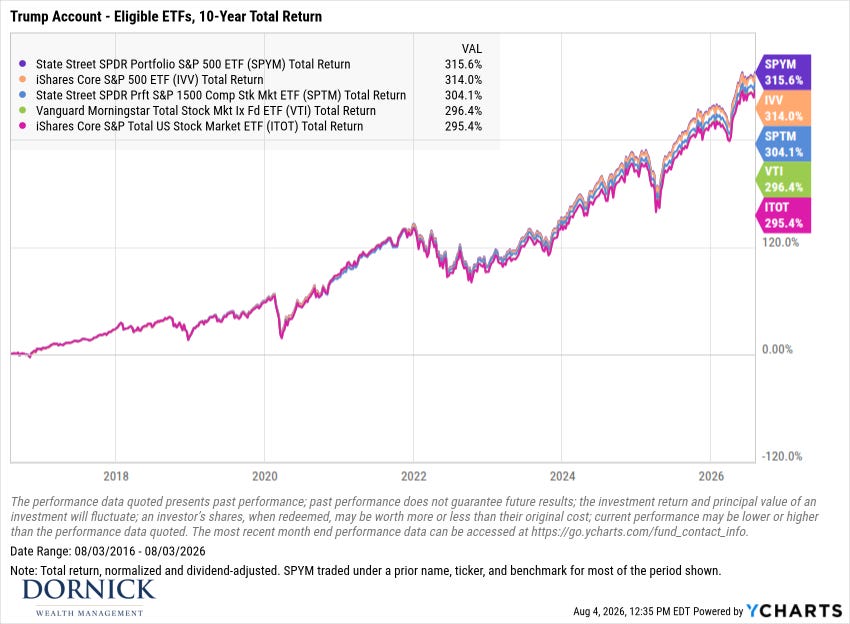
No individual stocks, bonds, crypto, or leverage, by law. Singles and doubles, not home runs and grand slams. Eighteen years is a long runway, and the design counts on time doing the work, not anyone trying to outsmart the market.
How Trump Accounts Stack Up
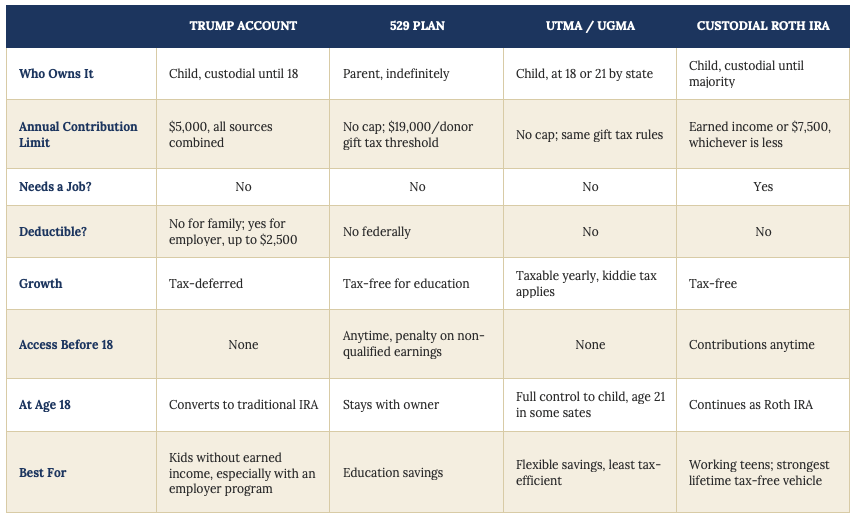
The custodial Roth wins for a working teenager. The 529 wins for education savings with easier access. The Trump Account earns its place for kids without earned income, and especially for owners who can fund it through the business instead of an after-tax gift.
The Bottom Line
Consider opening the account for kids under 18, seed money or not. If family plans to contribute beyond that, it’s after-tax, like any gift. If you own your own business, look at a written Trump Account Contribution Program before assuming a personal check is your only option. Mark the calendar for the year each child turns 18. A well-timed Roth conversion in that window could have a meaningful long-term impact.
This is one of the more interesting financial planning tools to come along in a while, not for the politics attached to the name, but for the after-tax outcomes a family can build with a little planning.
Related reading: my breakdown of 529 accounts and SEP IRA vs. Solo 401(k) for solo business owners.

Dornick Wealth Management LLC (“Dornick”) is a registered investment advisor in Texas and other jurisdictions where exempted. Registration as an investment advisor does not imply any specific level of skill or training.
The content of this newsletter is for informational purposes only and does not constitute financial, investment, tax, legal, or accounting advice. While efforts are made to ensure accuracy, the information may not be complete, up to date, or applicable to your individual circumstances. It is not an offer or solicitation to buy or sell any securities or investments, nor does it endorse any specific company, security, or investment strategy. Readers should not rely on this content as the sole basis for any investment or financial decisions.
Past performance is not indicative of future results. Investing involves risks, including the potential loss of principal. There is no guarantee that any investment strategies discussed will result in profits or avoid losses.
All information is provided “as-is” without any warranties, express or implied. Dornick does not warrant the accuracy, completeness, or reliability of the information presented. Opinions expressed are those of the author, Levi Pettit, and are subject to change without notice.
No advisor-client or fiduciary relationship is formed by use of this blog or newsletter. For advice tailored to your personal situation, please consult with a qualified financial advisor, tax professional, or attorney.
Dornick is not responsible for any errors or omissions, nor for any direct, indirect, or consequential damages resulting from the use or reliance on this information. Use of the content is at your own risk. This content is not intended as an offer or solicitation in any jurisdiction where such an offer or solicitation would be illegal.
Sources